

15.10.2026
Case Studies


Case Study :: Mythos – Launching a New Seaside Restaurant Together With Its Website


READING TIME: MIN
Table of Content
Most restaurant websites are built for a restaurant that already exists – there are photographs, a menu that has settled, reviews, a name people know. Mythos had none of that. It is a brand-new Greek restaurant on the seashore at St. Constantine & Helena, and the site had to open at the same moment the doors did.
That changes the job. The site is not a reference for people who already know the place – it is the first impression, the first menu anyone reads, and the first reservation channel. It has to say what kind of evening this is in about three seconds, in Bulgarian and in English, to someone standing on the promenade looking for dinner.
We designed and built it as a bespoke single-page site on Next.js, delivered from Cloudflare’s network, with the restaurant’s own printed menu and wine list readable in the page and reservations arriving as e-mail – no CMS, no plugins, no monthly platform.
Project Overview
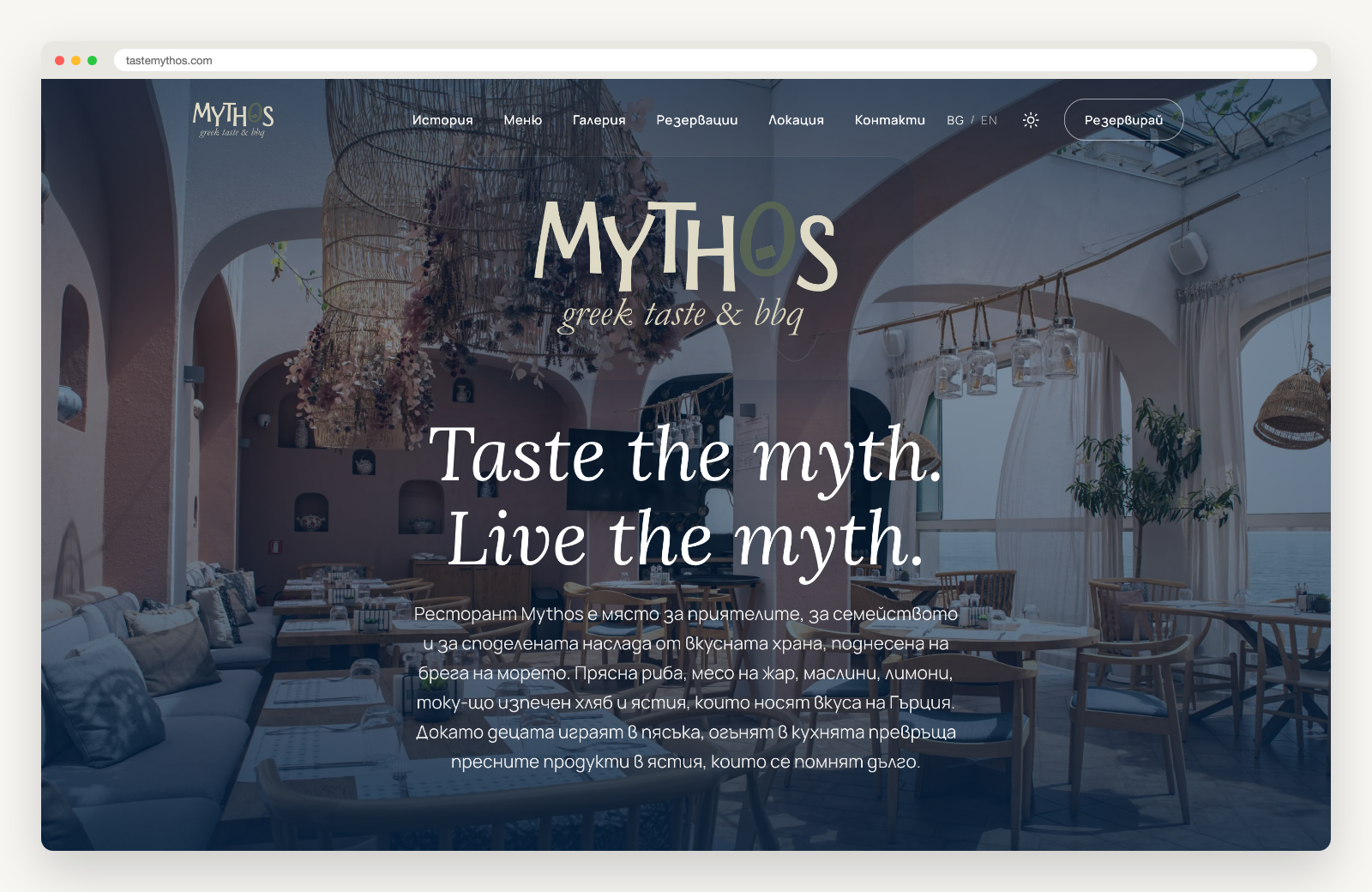
Mythos is Greek food by the Black Sea: fresh fish, meat over fire, olives, lemons and bread out of the oven. The site is one scrolling page – the story, the kitchen, the gallery, the menus, the location and the reservation – in two languages, with a light and a dark version of the whole design.
Everything a guest needs is one tap away on a phone: the phone number, directions in Google Maps or Waze, the menu, and a reservation form. The domain, the certificate and the DNS were set up as part of the launch, with the restaurant’s mail left untouched.
Objectives
- Open together with the restaurant – a complete, finished site on day one, not a “coming soon” page
- Make the food and the room the content: full-width photography, a hero that moves gently between images
- Show the printed menu and the wine list as booklets, in Bulgarian and English, exactly as they are on the table
- Take reservations through the restaurant’s booking system, with an e-mail form that takes over if the widget is unavailable
- Bulgarian and English from the start, both indexable, with proper canonical and hreflang tags
- A site the owners do not have to maintain, update or pay a subscription for
Key Features
A first impression that loads instantly
The page opens on a slow cross-fade between hero photographs – no sliding, no movement that fights with the text – over the restaurant’s name and a single line about what it is. The images are optimised and cached per device, so the first screen appears immediately even on mobile data in August, when every network on the coast is saturated.
Light and dark, both designed
The whole site exists in a light and a dark palette, switched from the header and remembered between visits, and the choice is applied before the first paint so the page never flashes the wrong colours. In practice the dark version is what people see in the evening – which is when they are deciding where to have dinner.
The real menu, in the page
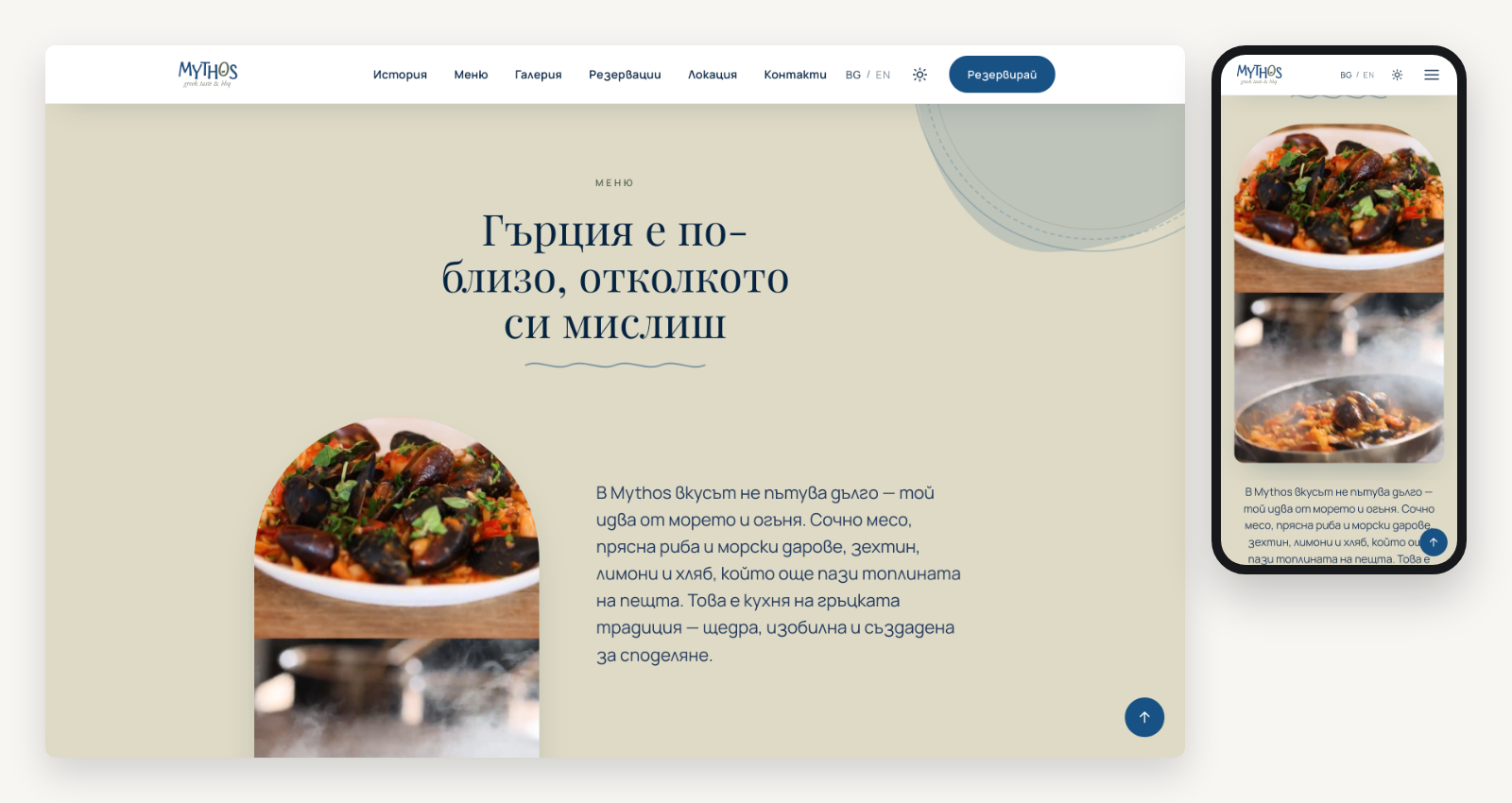
The kitchen gave us the print files of the menu and the wine list in both languages. Instead of linking to PDFs, the site renders them as booklets you flip through, wrapped in the restaurant’s actual printed covers, in the language of the page you are on. The viewer is only downloaded when a guest opens a menu, so browsing the rest of the site costs nothing extra.
Reservations, with a fallback that always works
The reservation section loads the booking widget of the restaurant’s reservation system. If the widget is not available – a blocked script, a slow network, a service outage – a reservation form takes its place without the guest noticing: it is checked by Cloudflare Turnstile and sent by SMTP to the restaurant’s mailbox. If even that fails, the section shows the phone number. A guest who wants a table never reaches a dead end.
Found from the first week
A new restaurant has no history in Google, so the technical side has to be right from day one: a Restaurant entity in structured data with cuisine, address, phone, images and social profiles, titles and descriptions per language, canonical URLs, hreflang pairs, Open Graph images, a sitemap and robots rules. That is also what an AI assistant reads when someone asks it for a Greek restaurant near St. Constantine & Helena.
Built for the person standing outside
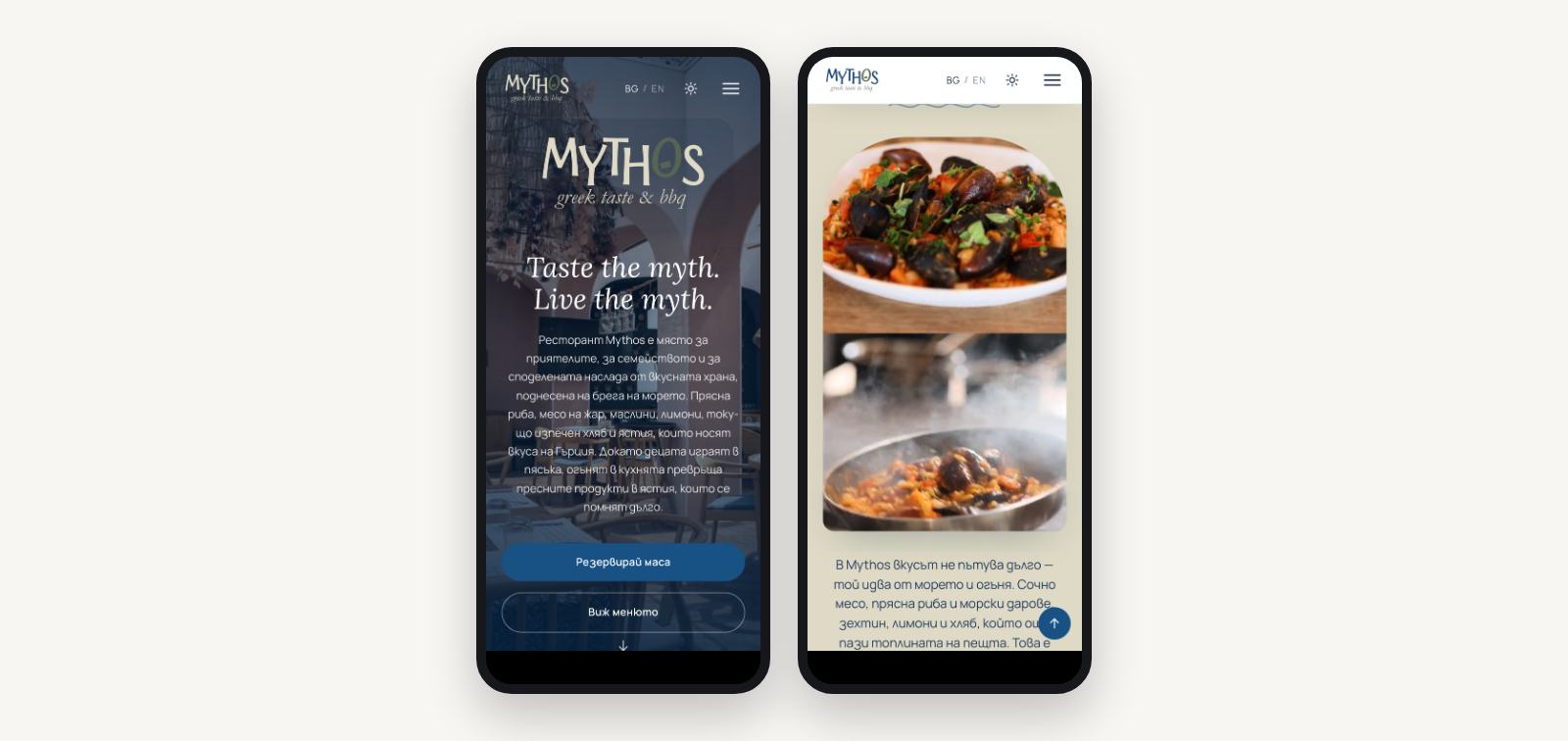
Most of the traffic is on a phone, nearby, right now. The header keeps the phone number and the reservation button within reach the whole way down the page; the location section opens Google Maps or Waze with one tap; the gallery opens in a full-screen lightbox; and nothing on the page requires a second load before it is useful.
Technology Stack
- Front end: Next.js 16 (App Router), React 19, TypeScript and hand-written CSS – no theme, no page builder
- Hosting: a single Cloudflare Worker through OpenNext – no server, no database, global edge delivery
- Images: the Cloudflare Images binding behind the Next.js image pipeline
- Menus: PDF.js and StPageFlip over the restaurant’s print files, loaded on demand, per language
- Reservations: the booking widget of the reservation system, with a Turnstile-checked form and a Workers SMTP client as the fallback
- Bilingual: BG at the root, EN under
/en, with canonical, hreflang and localised Open Graph - SEO: schema.org Restaurant and WebSite, generated sitemap and robots
- Domain & TLS: Workers custom domains – Cloudflare issues the DNS records and the certificate itself, leaving the mail records alone
Architecture Highlights
- Nothing on the site depends on a database or an admin panel, so there is no login to compromise and no update that can break a page the night before a busy weekend
- The theme choice is written before the first paint, which is why the dark version never flashes white
- Both languages are real pages with their own addresses and metadata – not a client-side translation layer that search engines cannot index
- Every heavy component (menu viewer, lightbox, maps) is loaded only on demand
- The reservation flow degrades in steps – widget, form, telephone – so a guest always has a way through
- Content lives in typed files in the repository: a change is a small edit and a deploy, and a mistake fails the build rather than the site
Results
Mythos opened with a finished bilingual site: its story, its photography, its real menu and wine list, its location, and a reservation path that works even when a third-party widget does not. There is no CMS to maintain, no plugin to update and no monthly platform fee – the site runs on Cloudflare’s network and costs the restaurant almost nothing to keep online.
See it live at tastemythos.com.
Why Partner With Vipe Studio
Opening a venue is the one moment when a website pays for itself immediately – it is how the first guests find you, read your menu and book a table before anyone has written a review. That only works if the site is finished, fast and correct on the day you open.
We build exactly that: a designed, bilingual site around your menu and your photography, with the domain, the certificate, the reservation flow and the Google basics handled for you, on infrastructure with no running maintenance. Tell us when you open and we will plan the launch backwards from that date.
More on The Topic
- Case Study :: Villa Chinka – A Restaurant and a Hotel on One Site, in Four Languages
- Case Study :: MORE – Three Black Sea Restaurants on One Next.js Site
- Case Study :: Story Gym – 24/7 Gym Access App with QR Turnstile and Card Payments
- Case Study :: Coach by Vipe – Coaching Platform and Mobile App for Sports Teams
- Case Study :: Custom Financial Education Platform with Multi-Level Learning System
The content of this website is copyrighted and protected by Creative Commons 4.0.